
KMSC Blog
Fresh Graduates and the Leadership Gap: Is It a Lack of Life Exposure or an Inadequate Curriculum?
Are young graduates lacking leadership because they have not had enough exposure to life, or because our educational curriculum has not adequately prepared them for leadership?
By Dr. Sundar Subramani kautilya management system consultancy ·
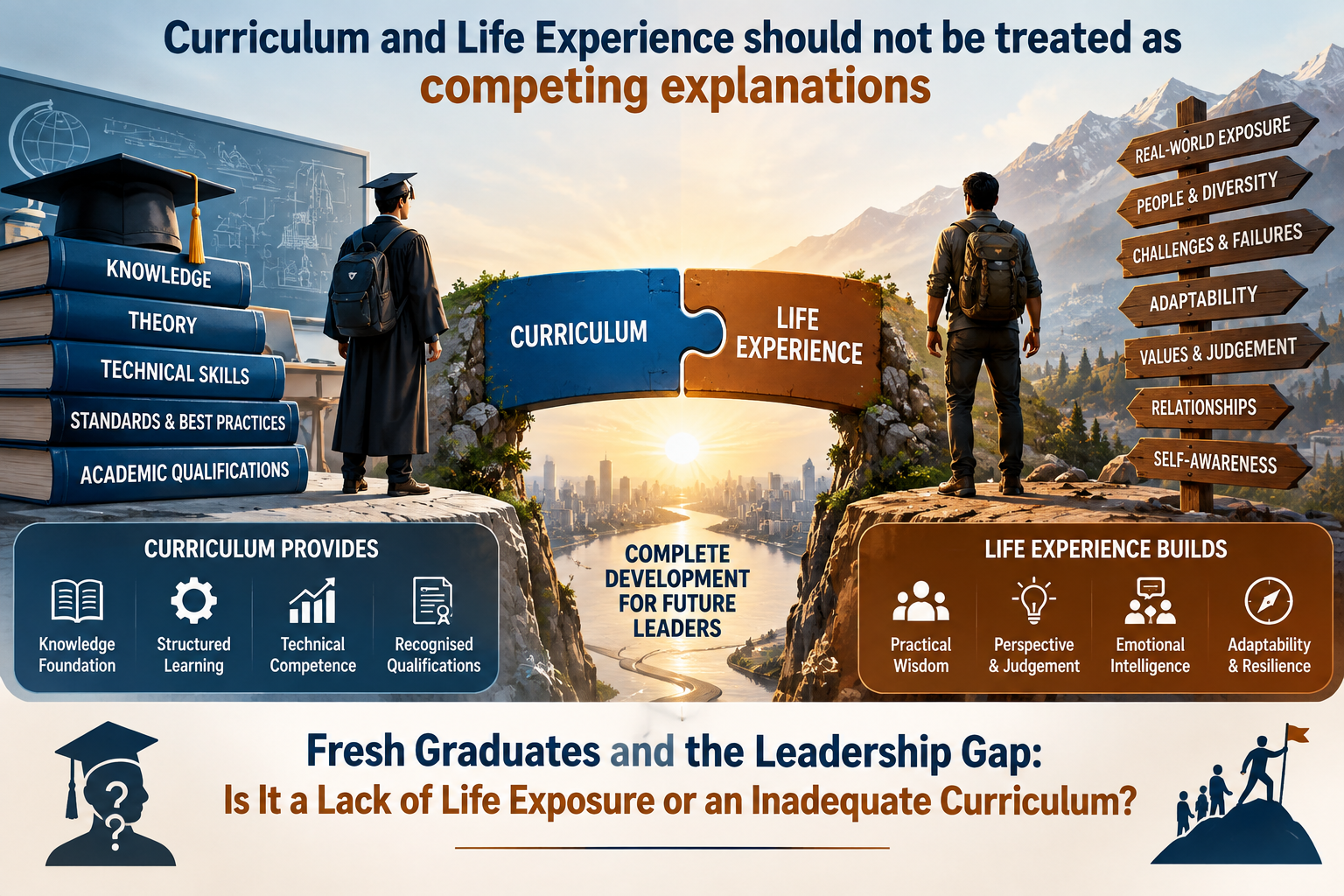
Fresh Graduates and the Leadership Gap: Is It a Lack of Life Exposure or an Inadequate Curriculum? A common complaint in today’s workplaces is that fresh graduates arrive with impressive academic qualifications but struggle to demonstrate leadership. They may know the theory, understand technology, perform well in examinations and even communicate confidently in interviews. Yet, when they are placed in a real workplace, some find it difficult to take initiative, handle conflict, make decisions under uncertainty, influence others or take responsibility when things do not go according to plan. This raises an important question: Are young graduates lacking leadership because they have not had enough exposure to life, or because our educational curriculum has not adequately prepared them for leadership? The answer is probably more complicated than either explanation suggests. Leadership is not simply a subject that can be learned from a textbook. At the same time, it is not something that young people automatically acquire merely by growing older. Leadership develops through a combination of knowledge, experience, reflection, responsibility, social interaction, feedback and opportunities to practise. Recent research increasingly supports this more balanced view. The problem may begin with how we define leadership When organisations say that a fresh graduate "lacks leadership," they may not necessarily mean that the graduate cannot become a leader. A 22-year-old entering their first job is unlikely to have the same leadership experience as someone who has spent ten years managing people, dealing with difficult customers, negotiating with colleagues or making decisions with incomplete information. Perhaps, therefore, the more useful question is not: "Why can't graduates lead?" It is: "Have graduates been given enough opportunities to practise leadership before we expect them to demonstrate it?" This distinction matters. Leadership includes much more than holding a position or telling other people what to do. It involves listening, influencing, communicating, taking responsibility, resolving disagreements, making decisions, understanding different perspectives and learning from mistakes. A systematic review by Lee and Chan, examining 54 empirical studies on university students, found that leadership development is influenced by both student-centred factors—such as personal experiences, skills and beliefs—and environmental and contextual factors, including relationships, opportunities and social influences. In other words, leadership development does not come from one source. It emerges from an interaction between the individual and the environment. SScienceDirect That finding provides an important clue to the graduate leadership debate. Life exposure matters—but not everyone gets the same exposure There is some truth to the argument that young graduates may lack "life exposure." A person who has worked part-time, volunteered, organised community activities, participated in student organisations, travelled, lived away from home, managed a project or worked with people from different backgrounds may have encountered situations that require initiative and negotiation. These experiences can teach lessons that a classroom sometimes struggles to reproduce. Imagine two students. The first student has spent four years attending lectures, preparing assignments and writing examinations. Their academic performance may be excellent. The second student has done similar academic work but has also organised a college event, coordinated a student team, worked part-time, volunteered in a community programme and dealt with disagreements among team members. Both may graduate with the same degree. But they have not had the same opportunities to practise leadership. This does not mean that the second student is automatically a better leader. It simply means that they have had more opportunities to encounter situations in which leadership behaviours can be developed. Research by Jackson and Bridgstock supports the importance of such experiences. Their study of 510 Business and Creative Industries graduates across three Australian universities examined curricular, co-curricular, extracurricular activities and paid work. Graduates regarded internships and extracurricular activities as particularly useful for developing skills and gaining experience. DDOI+1 The lesson is significant: experience outside the traditional classroom can contribute meaningfully to employability and skill development. But "lack of life exposure" can become an unfair explanation There is also a danger in blaming graduates for not having enough life experience. Not every student has the same socioeconomic circumstances. Some students can afford internships, travel, volunteering and extracurricular activities. Others have to spend their university years concentrating on academic work or earning money. Some students grow up in environments where they are encouraged to speak up and make decisions. Others come from cultures, families or educational environments where questioning authority is discouraged. Therefore, telling young graduates simply to "get more exposure" can overlook an important issue: Who is providing that exposure, and who has access to it? Universities cannot control everything that happens in a student's life, but they can create opportunities that allow students from different backgrounds to practise leadership. This is where curriculum becomes important. The curriculum may teach leadership—but does it allow students to practise it? Many educational programmes teach leadership as a concept. Students may learn about leadership theories, leadership styles, organisational behaviour, motivation and team management. They may even be asked to write assignments about transformational leadership or complete examinations on leadership theories. But there is a fundamental difference between knowing what leadership is and actually leading people. A student can explain conflict-management theory perfectly and still struggle when two members of their project team refuse to cooperate. A student can define delegation but struggle to delegate when they are personally responsible for the outcome. A student can describe effective communication but become uncomfortable when they have to give difficult feedback to another person. This is the difference between declarative knowledge and applied capability. Research on higher-education leadership development provides evidence for this distinction. Reyes and colleagues conducted a meta-analysis and critical review of leadership-development programmes in higher education. Their findings indicate that leadership-development programmes can work, while also highlighting the need for better alignment between evidence-based leadership-development practices and how such programmes are implemented in higher education. SScienceDirect More recent research has reached a similar conclusion. A 2025 study examining leadership development in U.S. higher education found that leadership education can remain heavily theoretical and identified experiential learning, mentoring, adaptability training and external partnerships as important approaches for making leadership development more applied. SScienceDirect+1 So the issue may not be that universities are teaching the "wrong" things. It may be that students are not getting enough opportunities to convert what they learn into behaviour. Leadership cannot be learned entirely through lectures Consider how we learn to drive. We can study the traffic rules. We can memorise road signs. We can understand how a car works. But none of those things makes someone an experienced driver. Eventually, the learner has to sit behind the wheel. Leadership is similar. A student needs opportunities to make decisions, experience consequences, receive feedback, reflect and try again. This is the basic logic behind experiential learning. A 2024 study by Amenumey and Badu, drawing on Kolb's experiential learning theory and the 70:20:10 model, examined leadership development in a higher-education context. Their work highlighted learning through on-the-job tasks, workplace relationships and formal training, and argued for deliberately integrating these sources of learning rather than treating them separately. B Boston College Journals The implication for universities is straightforward: Don't just teach students about leadership. Put them in situations where they have to lead. What could this look like in a university? Leadership development does not necessarily require adding another three-credit course called "Leadership Skills." Instead, leadership can be integrated into existing learning. For example: • Instead of giving every student the same group assignment, students could rotate leadership responsibilities. • Students could be asked to manage a real project for an external organisation. • Assessment could include peer feedback on collaboration and leadership behaviour. • Students could participate in community-based projects where they have to solve an actual problem. • Internships could include structured reflection rather than simply attendance. • Students could be given responsibility for organising events, managing budgets or coordinating teams. • Case studies could be replaced or supplemented with simulations involving conflict, negotiation and decision-making. • Faculty members and industry professionals could provide mentoring. • Students could maintain reflective portfolios documenting situations in which they exercised initiative, handled failure or resolved conflict. The important word here is structured. Simply telling students to participate in extracurricular activities is not enough. The experience becomes considerably more educational when students are asked to reflect on what happened, understand why it happened and consider what they would do differently next time. Employers see a gap too The concern about graduate readiness is not merely anecdotal. Research from the National Association of Colleges and Employers (NACE) shows a noticeable difference between how graduates and employers perceive career-readiness competencies. In NACE's 2024 Student Survey and Job Outlook 2025 survey, 84.6% of new graduates considered leadership very or extremely important, while 66.0% rated themselves very or extremely proficient in it. Among employers, 45.0% considered leadership very or extremely important, while only 31.0% rated new graduates as very or extremely proficient. DDefault The numbers should not be interpreted as proof that graduates "cannot lead." Surveys of perceived proficiency have obvious limitations. However, they reveal something important: there is a perception gap between graduates and employers about readiness. That gap itself deserves attention. A graduate may think, "I led my college project, so I have leadership experience." An employer may think, "But have you managed a disagreement between colleagues, handled an unhappy client, taken responsibility for a failed project or made a difficult decision under pressure?" Both perspectives can be understandable. The problem is that the word leadership may mean different things to different people. Perhaps the real missing ingredient is responsibility There is another dimension that deserves greater attention: consequence. University assignments often have relatively predictable consequences. If a project fails, the grade may suffer. In professional life, the consequences can be much more complicated. A poor decision may affect a customer. A communication failure may damage trust. A missed deadline may affect an entire team. A badly handled disagreement may result in someone leaving the organisation. Leadership develops partly when people learn to operate in situations where their decisions affect others. Universities cannot replicate every workplace consequence, nor should they try to. But they can create authentic responsibility. Students could be given real problems, real stakeholders, limited resources and genuine deadlines. That would move education from: "Here is a problem. Find the correct answer." towards: "Here is a problem. You are responsible for working with others to find a workable solution." That is much closer to the reality of leadership. Curriculum and life experience should not be treated as competing explanations The debate is often framed as an either-or question: Is the problem lack of life exposure or inadequate curriculum? The research suggests that this is probably the wrong way to frame it. Leadership development is influenced by personal experiences as well as contextual and educational opportunities. Science Direct A student with rich experiences may enter university with a head start. A well-designed university programme can then build on those experiences. Conversely, a student with limited opportunities outside the classroom can benefit enormously if the university deliberately creates meaningful leadership experiences. In this sense, education can compensate, to some extent, for unequal exposure. But education cannot do everything. Universities cannot manufacture maturity overnight. Likewise, employers cannot reasonably expect a 21-year-old graduate to possess the leadership judgement of a 35-year-old manager. There has to be a developmental continuum. Employers also have a role The responsibility does not end at graduation. Organisations sometimes advertise entry-level positions while expecting candidates to demonstrate communication, leadership, strategic thinking, problem-solving and industry experience simultaneously. That can create an unrealistic expectation. A fresh graduate should certainly be expected to demonstrate potential, initiative and a willingness to learn. But organisations also have a role in developing early-career talent through mentoring, coaching, meaningful assignments and gradual increases in responsibility. Interestingly, NACE's 2026 research indicates that employers generally regard new graduates as reasonably prepared for the jobs they enter, although employers still identify areas where graduates can improve, particularly communication, professionalism and critical thinking. DDefault This is worth remembering. The graduate leadership problem should not become another simplistic story about "young people lacking skills." The evidence suggests a more nuanced reality. From "graduate" to "professional" Perhaps the biggest transition after university is not from student to employee. It is from learner to contributor. A student is often rewarded for finding the correct answer. A professional is often required to work when there is no obvious correct answer. A student can sometimes complete an assignment independently. A professional must depend on others. A student may be assessed by a lecturer. A professional receives feedback from customers, colleagues, managers and sometimes the market itself. And a student can often avoid difficult conversations. A leader cannot. That transition requires more than academic knowledge. It requires judgement. And judgement is built through a combination of knowledge + experience + reflection + feedback + responsibility. What should universities do differently? If the goal is to produce graduates who are more prepared to lead, universities could consider five changes.
- Move leadership from the margins into the curriculum Leadership should not exist only as an elective course or student-club activity. Elements of leadership—communication, decision-making, collaboration, conflict management, ethical reasoning and self-awareness—can be integrated into ordinary academic subjects.
- Increase authentic experiential learning Students should encounter real problems rather than exclusively simulated academic problems. Internships, service learning, industry projects, consulting assignments and community projects can create opportunities for students to practise leadership. Research by Jackson and Bridgstock found that internships and extracurricular activities were perceived by graduates as valuable for developing skills and gaining experience. DDOI
- Make reflection part of the learning process Experience by itself does not automatically create leadership. Students need to ask: • What happened? • What did I do? • Why did I respond that way? • What did I learn? • How did others experience my behaviour? • What would I do differently next time? Reflection turns experience into learning.
- Give students meaningful responsibility Students should not simply be "participants." They should sometimes be responsible for outcomes. Let them manage projects, budgets, teams, events and community initiatives—with appropriate supervision.
- Build stronger university-industry partnerships Employers can help universities understand what leadership looks like in actual workplaces. Universities can provide the conceptual foundation. Industry can provide authentic problems and contexts. Students can provide the energy and willingness to experiment. That three-way relationship can make leadership education much more meaningful. The responsibility of the student Universities have responsibilities, but students cannot outsource their development. A student who wants to become a leader should actively seek situations that are uncomfortable. Volunteer to coordinate something. Take responsibility when a project is going badly. Learn to speak to people with different opinions. Ask for feedback. Work part-time if circumstances permit. Participate in community activities. Join multidisciplinary teams. Try something where failure is possible. Most importantly, learn to reflect on those experiences. Leadership does not begin when someone receives the title "manager." It begins when someone accepts responsibility for an outcome that affects other people. So, is it lack of exposure or inadequate curriculum? The evidence does not support a simple verdict. It is both—and neither, by itself. Some fresh graduates may lack exposure to situations that develop confidence, judgement and interpersonal skills. At the same time, universities may not always provide enough structured opportunities to practise leadership in authentic contexts. Research on student leadership increasingly points toward an interaction between personal characteristics and environmental opportunities. SScienceDirect Research on graduate employability similarly highlights the value of internships, extracurricular experiences and other forms of experiential learning. DDOI And research specifically examining higher-education leadership development suggests that structured programmes can contribute to leadership development, particularly when learning moves beyond theory into experience and reflection. SScienceDirect Therefore, the solution is unlikely to be another lecture on "ten qualities of a good leader." The better solution may be to redesign the learning journey itself. Give students knowledge. Give them experience. Give them responsibility. Give them feedback. Give them opportunities to fail safely and learn. And then give them another opportunity to try. Because leadership is rarely produced by exposure alone, and it is rarely produced by curriculum alone. It develops when education creates the conditions in which experience can become learning—and learning can become responsible action. References
- Lee, K. K. W., & Chan, C. K. Y. (2024). Establishing a dynamic understanding of factors that influence university students’ leadership approaches, perceptions, and skills through a systematic literature review. Educational Review. DOI: 10.1016/j.edurev.2023.100570. SScienceDirect
- Reyes, D. L., Dinh, J., Lacerenza, C. N., Marlow, S. L., Joseph, D. L., & Salas, E. (2019). The state of higher education leadership development program evaluation: A meta-analysis, critical review, and recommendations. The Leadership Quarterly, 30(5), 101311. DOI: 10.1016/j.leaqua.2019.101311. SScienceDirect
- Jackson, D., & Bridgstock, R. (2021). What actually works to enhance graduate employability? The relative value of curricular, co-curricular, and extra-curricular learning and paid work. Higher Education, 81, 723–739. DOI: 10.1007/s10734-020-00570-x. DDOI
- Amenumey, E. B., & Badu, Y. A. (2024). Leaders’ Experiences of Integrated Leadership Development in Higher Education: Kolb’s Experiential Learning Theory and the 70:20:10 Model. International Journal of African Higher Education, 10(2), 113–137. DOI: 10.6017/ijahe.v10i2.17617. B Boston College Journals
- Gray, K. (2025). The Gap in Perceptions of New Grads’ Competency Proficiency and Resources to Shrink It. National Association of Colleges and Employers (NACE). DDefault
- Leadership development in U.S. Higher education: Strategies for lifelong learning and upskilling. Journal of Innovation & Knowledge, 10(4), 100754 (2025). DOI: 10.1016/j.jik.2025.100754. SScienceDirect
- Gatta, M. (2026). Employers Say New Grads Are Largely Prepared for Work, With Room to Improve. National Association of Colleges and Employers (NACE). DDefault
Tags: #3leadershipyounggraduates