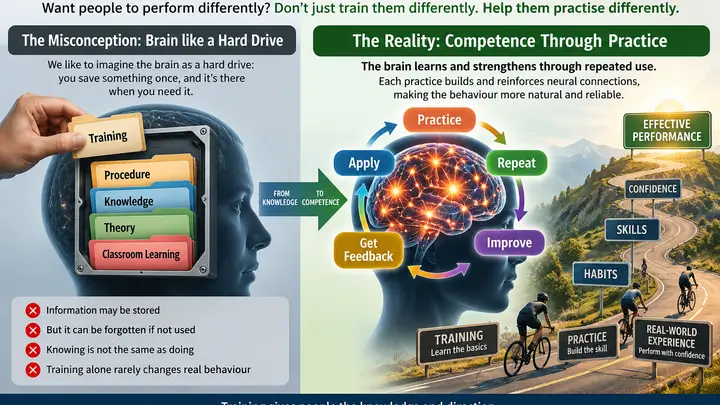
Want people to perform differently? Don't just train them differently. Help them practise differently.
We like to imagine the brain as a hard drive: you save something once, and it's there when you need it.
It doesn't work like that. Every time we recall something, the brain rebuilds it from past experience, associations, context, and how recently and how often we've used it.
Think of a student preparing for an exam. They studied the subject months ago, and the knowledge is probably still in there somewhere. But on exam day, it's stubborn about showing up.
Tags: Human Behaviour, Competence, Management, Leadership, Management Systems
The real challenge is not changing the documents. It is changing the way quality is managed.In fact, one of the most important messages from the revision is that the fundamental philosophy of ISO 9001 remains intact. Customer focus, the process approach, risk-based thinking, performance evaluation and continual improvement continue to form the foundation of the standard. ISO itself describes the revision as a targeted update intended to improve clarity, usability and relevance rather than introduce a fundamentally new management system.
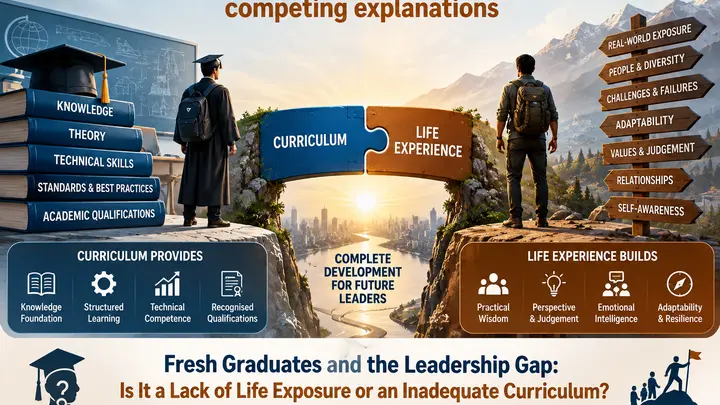
Are young graduates lacking leadership because they have not had enough exposure to life, or because our educational curriculum has not adequately prepared them for leadership?
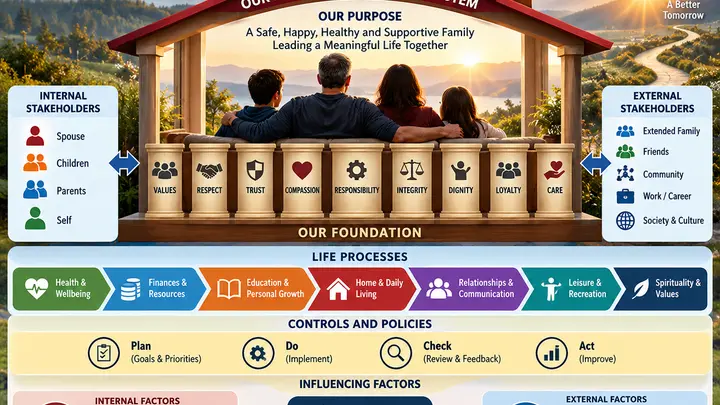
What if the most important management system you run isn’t at work, but at home? This post explores how the principles of management systems - goals, processes, controls, risk, communication, review and continuous improvement - can be applied to personal and family life. It’s not about making life bureaucratic; it’s about becoming more intentional, resilient and aligned with the values that matter most.