
KMSC Blog
Learning from Childhood and Training Days: Different Methods of Learning for Better Understanding and Retention
Learning becomes meaningful when children and trainees do more than listen or memorise.
By Dr. Sundar Subramani ·
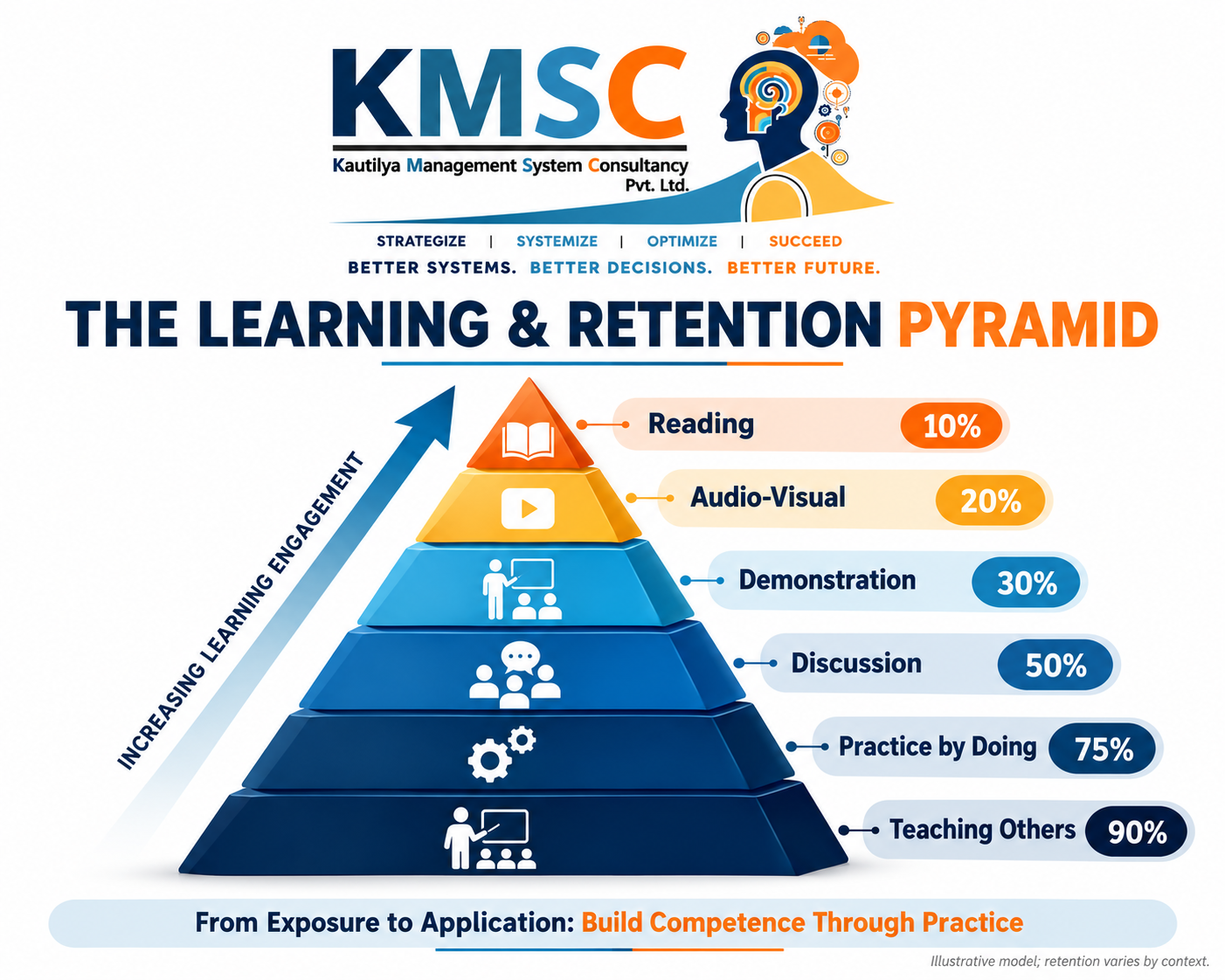
Learning becomes meaningful when children and trainees do more than listen or memorise. By observing, discussing, practising, reflecting and teaching others, learners can build deeper understanding and make knowledge easier to apply.
Introduction
Childhood and early training experiences lay the foundation for lifelong learning. The habits, knowledge and experiences developed during these years help shape personality, thinking, creativity and future performance. Learning, however, is not simply about listening to a teacher or mentor or memorising information from a textbook. It also involves understanding concepts, exploring ideas, practising skills, asking questions and applying knowledge in real-life situations.
The Learning and Retention Pyramid, commonly associated with the National Training Laboratories, illustrates a range of learning methods, from lectures and reading to group discussion, practical activities and teaching others. Its specific retention percentages should not be treated as universal scientific measurements. Its broader message remains useful: learners often engage more deeply when they actively participate in the learning process.
1. Learning Through Listening: The Foundation of Knowledge
Listening is one of the earliest ways children learn. From infancy, they listen to parents, family members, teachers, mentors and friends. Gradually, they recognise sounds, learn words, understand instructions and develop communication skills.
In classrooms and training settings, teachers and trainers introduce new concepts through explanations and storytelling. For example, they may explain the importance of trees, describe the water cycle or tell a story about honesty and kindness.
Listening alone may not be enough to help learners understand and remember what they hear. Explanations become more effective when supported by pictures, questions, demonstrations and practical experiences. Adults can help by speaking clearly, using familiar examples, encouraging questions and connecting new ideas with everyday situations.
2. Learning Through Reading: Developing Imagination and Understanding
Reading opens the door to knowledge, imagination and independent thinking. Books, stories, poems and informative texts help learners develop vocabulary, language skills, concentration and comprehension.
Reading introduces children and trainees to different cultures, people, places and ways of thinking. A story about a forest, for example, can prompt learning about animals, plants, environmental protection and living in harmony with nature.
Picture books, illustrated stories and simple sentences can make reading enjoyable for younger children. Older learners can explore novels, biographies, science books, newspapers and other materials. To improve understanding and retention, learners can summarise what they read, ask questions and connect information with their own experiences.
Reading should not become merely an examination-oriented activity. It should nurture curiosity, enjoyment and a lifelong desire to learn.
3. Learning Through Audio-Visual Methods: Seeing and Hearing Together
People may understand abstract or unfamiliar ideas more easily when they can see and hear information together. Audio-visual learning combines spoken explanations with pictures, diagrams, videos, models, animations and presentations.
For example, a learner may find it difficult to understand how the Earth revolves around the Sun through verbal explanation alone. A model or animation can make the concept easier to visualise. Educational songs can help children remember letters, numbers and new words, while videos can introduce them to animals and environments they may never encounter in person.
Teachers and trainers should choose accurate, age-appropriate and relevant materials. Screen-based learning should be balanced with conversation, outdoor exploration, physical activity and direct interaction with people and objects. The aim is to clarify concepts, not simply to entertain.
4. Learning Through Demonstration: Understanding by Observation
Children and adults often learn by watching others perform activities. Demonstration allows learners to see how a task is completed before attempting it themselves.
A teacher or trainer can demonstrate how to solve a mathematical problem, conduct a science experiment, plant a seed or use a measuring instrument. Parents can demonstrate everyday skills such as tying shoelaces, preparing a simple meal, organising materials or crossing a road safely.
Demonstration is particularly useful for practical skills because learners can observe the sequence of actions, notice important details and understand the correct procedure. After the demonstration, they should have an opportunity to practise independently. Mistakes should be treated as opportunities to improve, not reasons for criticism.
5. Learning Through Group Discussion: Sharing Ideas and Building Confidence
Group discussion gives learners opportunities to express their thoughts, listen to different opinions and learn from one another. It also develops communication, cooperation, reasoning and social skills.
After reading a story, children might discuss a character's behaviour and suggest alternative endings. In a science lesson or workplace training session, participants might discuss why plants need sunlight or how a particular risk can be controlled.
Discussion helps learners recognise that people may have different perspectives and that respectful disagreement is a natural part of learning. Facilitators should create an environment where everyone feels comfortable participating, including quieter learners. The aim is not to make every discussion a competition, but to encourage thoughtful questions and collective understanding.
6. Learning Through Practice by Doing: Turning Knowledge into Experience
Practical learning allows learners to apply what they have learned rather than simply remember information. It is valuable for developing skills and understanding how knowledge works in real life.
Children can learn mathematics by counting objects, measuring ingredients, handling money in pretend shops or calculating distances. Science can be explored by growing plants, observing insects or examining how shadows change. In professional training, learners can practise a procedure, use equipment, work through a case study or rehearse a response to a realistic situation.
Creative activities such as drawing, music, gardening, building models and craftwork also provide opportunities to learn through experience. When children grow a plant, they learn more than the names of its parts: they observe growth, understand the importance of water and sunlight, develop responsibility and practise patience.
Practical learning should suit the learner's age, ability and experience. Adults should provide safe materials, clear guidance and enough freedom to explore. Knowledge becomes more useful when it is connected to experience and applied in different situations.
7. Learning Through Play: The Natural Language of Childhood
Play is not a distraction from learning. It is an important part of childhood development. Through play, children explore their surroundings, experiment with ideas, develop relationships and discover their abilities.
Different forms of play support different areas of development:
• Physical play: running, jumping, climbing and ball games develop coordination, balance and fitness.
• Imaginative play: pretending to be a doctor, teacher, shopkeeper or chef encourages creativity, language and understanding of everyday roles.
• Building and construction: blocks, puzzles and construction toys develop spatial awareness, problem-solving and early mathematical thinking.
• Social play: games with others help children learn cooperation, fairness, patience and conflict resolution.
• Exploratory play: exploring sand, water, leaves, stones and other safe materials encourages curiosity and observation.
Play-based learning is especially useful in early childhood because it lets children learn at a comfortable pace while remaining engaged. Adults do not need to control every activity. Meaningful learning often happens when children are free to explore, make decisions and discover things for themselves.
8. Learning by Teaching Others: Strengthening Understanding
When learners teach what they have learned, they must organise their thoughts, identify important information, explain concepts clearly and respond to questions. This process can reveal gaps in understanding and encourage deeper thinking.
After learning about the solar system, a child might explain the planets to a parent using a drawing or model. In a workplace setting, a trainee might demonstrate a procedure to a colleague or explain the reasoning behind a safety control.
Classroom and training activities can include presentations, peer tutoring, demonstrations, storytelling and small-group projects. Teaching others can develop confidence, leadership, communication, empathy and responsibility. It works best when learners receive guidance, feedback and opportunities to correct misunderstandings.
9. Learning Through Real-Life Experiences: Connecting Learning with Life
Learning becomes more meaningful when learners connect what happens in a classroom or training room with the world around them.
A visit to a market can help children understand numbers, money, measurement and social interaction. A farm visit can introduce plants, animals and food production. In professional settings, workplace visits, case studies and realistic simulations help trainees see how procedures and principles apply in practice.
Everyday activities also offer valuable learning opportunities. Cooking with adult supervision introduces measurement and sequencing. Planning an outing involves time, budgeting and decision-making. Learners should be encouraged to ask questions such as:
• Why does this happen?
• How does this work?
• What would happen if we changed something?
• How can we solve this problem?
Questions like these encourage scientific thinking and independent reasoning. They also show that learning does not end when people leave the classroom.
10. Learning Through Reflection and Repetition: Making Learning Last
Learners may understand an idea during a lesson but forget it later if they do not revisit or use it. Revisiting information at appropriate intervals helps strengthen memory and makes knowledge easier to retrieve.
Instead of repeatedly reading the same page without thinking, learners can use active recall by trying to remember information before checking the answer. After studying the parts of a plant, for example, a child can draw and label it from memory. After learning new words, the child can use them in sentences the next day.
Reflection is equally important. Learners can consider what they learned, what they found difficult, what they enjoyed and how they might use the knowledge. Reviewing errors and trying again can build perseverance and a willingness to improve.
A balanced learning routine includes practice, feedback, rest, reflection and opportunities to apply knowledge in new contexts.
11. Learning Through Creativity and Problem-Solving
People express creativity in different ways. Some enjoy drawing and music, while others prefer building objects, solving puzzles, asking scientific questions or creating stories. Creative learning encourages learners to imagine possibilities, experiment with different approaches and develop original ideas.
Teachers can ask children to design a bridge using simple materials, invent a story from a picture or create a poster about saving water. Trainers can present realistic problems and ask participants to identify options, weigh risks and justify their decisions.
Problem-solving activities help learners recognise that a challenge may have more than one solution. Rather than immediately providing the answer, adults can offer hints and ask questions that guide learners towards discovering a solution. This develops independent thinking, flexibility, curiosity and confidence when facing unfamiliar situations.
12. Learning Through Emotional Support and Positive Relationships
Emotional well-being influences a learner's ability to participate. People who feel safe, respected and encouraged are generally better positioned to ask questions, attempt difficult tasks and learn from mistakes.
Parents, teachers and trainers can support learning by listening patiently, recognising effort, offering constructive feedback and avoiding humiliating comparisons. Learners develop at different paces and may show strengths in language, movement, music, visual thinking, social interaction or practical tasks. These differences should be recognised without placing people into rigid categories.
A supportive learning environment does not remove every challenge. It provides the encouragement, resources, time and guidance learners need to work through challenges successfully. When learning is associated with curiosity, achievement and supportive relationships, people are more likely to remain interested in learning.
Conclusion: Creating Lifelong Learners
The Learning and Retention Pyramid reminds us that learning extends beyond listening to lectures and reading textbooks. Children and trainees can benefit from a combination of listening, reading, observation, demonstration, discussion, practical experience, play, reflection and teaching others.
No single method is ideal for every learner or every subject. Listening may introduce a new topic, visual materials may clarify a difficult concept, practical activities may develop a skill, and teaching others may strengthen understanding. The best approach depends on the learner's age, needs, subject matter and previous experience.
Parents, teachers, trainers and educational institutions share responsibility for creating environments where learners can explore, question, practise, collaborate and grow. Education should not focus only on examination marks or the ability to memorise facts. It should also develop creativity, critical thinking, communication, practical competence, emotional maturity and responsibility.
The real purpose of education and training is not merely to help people remember what they are taught. It is to help them understand the world, think independently, apply their knowledge and continue learning throughout their lives. When learners are encouraged to learn through experience, supported by caring adults and given opportunities to share their knowledge, learning becomes more than a classroom activity. It becomes a natural and rewarding part of everyday life.
Tags: learning, pyramid, retention