
KMSC Blog
Managing Life and Family as a Management System
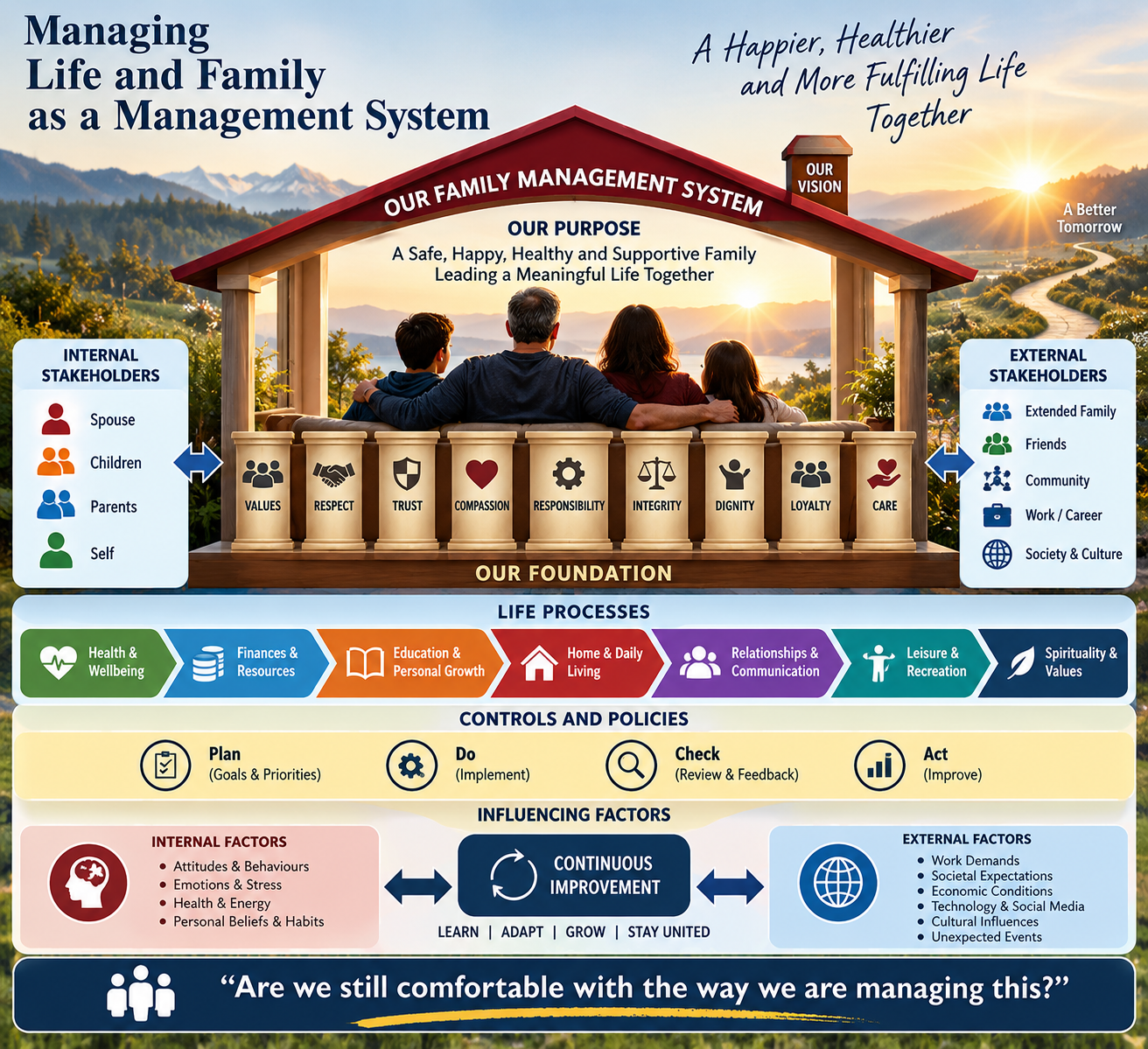
What if the most important management system you run isn’t at work, but at home? This post explores how the principles of management systems - goals, processes, controls, risk, communication, review and continuous improvement - can be applied to personal and family life. It’s not about making life bureaucratic; it’s about becoming more intentional, resilient and aligned with the values that matter most.
By Dr. Sundar Subramani ·
Say "management system" and most of us picture offices: ISO certificates, audit season, binders of procedures, dashboards nobody reads. But you don't need a company to have one. You're running one right now, whether or not you've ever called it that.
Your life and your family have goals, routines, checks and balances, people who influence you, risks you worry about (or should), and decisions that lead to outcomes. The only real difference is that a business writes its system down, while most of us have never stopped to look at the one we live inside.
Life is a process
A process is just a chain of activities that turns inputs into outputs. Think about an ordinary day. You wake up, plan, work, earn, spend, eat, exercise, talk to people, fix problems, rest, and get ready to do it again. None of it happens in isolation.
Health gives you energy. Energy shapes how well you work. Work brings income, income brings security at home, and a secure home is good for your relationships and your peace of mind, which in turn feed back into your health. It's a loop.
That's also why trouble spreads. Sleep badly and you can't concentrate. Can't concentrate and work gets stressful. Stressed at work and you come home short-tempered. Tension at home, and you're back to sleeping badly. To manage life well, it isn't enough to look at each piece on its own. You have to see how they push on each other.
Every family has policies, written or not
Organisations write policies to set boundaries for decisions. Families have them too, they just live in people's heads. You'll recognise them:
- "We look out for each other."
- "No hiding important things."
- "Education comes first."
- "Save before you spend."
- "Everyone gets their own space."
- "We eat together when we can."
- "Big decisions get talked through."
The trouble is that unwritten rules get interpreted differently by everyone. What you think is obvious may be news to your spouse or teenager. Saying the important ones out loud clears up a lot of quiet misunderstanding. A healthy family doesn't need a thick manual. It needs to be clear on what matters and how decisions get made.
Controls keep things on track
In business, controls are approvals, budgets, inspections and reviews. At home they can be much simpler: a monthly look at your spending, a regular health check that catches problems early, a family chat before a small irritation becomes a big one, a calendar so you stop forgetting things, and an agreed way of handling disagreements so tempers don't take over.
Controls aren't there to fence life in. They just keep it from drifting somewhere you didn't mean to go.
Who gets a say in your life
Management systems talk about "interested parties", the people who have a stake in what you do and can influence it. At work that's customers, staff, suppliers, regulators and shareholders. At home it's much more personal.
Internal stakeholders are your spouse, children, parents, siblings and anyone else in the household.
External stakeholders are friends, employers and colleagues, schools, doctors, banks, neighbours, your wider community, government bodies, and your social and professional networks.
All of them influence what you decide, expect and do. But they shouldn't all carry equal weight. Your employer may have a say over your working hours, but not over your family's values. Your friends may shape your lifestyle, but they shouldn't set your financial priorities.
Culture matters here too, and it varies enormously. In much of Asia, the community and neighbours have a strong say in how people live. In much of the West and the Americas, the attitude is closer to "not my business unless it affects me". Neither is simply right or wrong, but knowing which way your surroundings lean helps you decide how much weight to give them.
And social media may shape your idea of success, but it doesn't get to define what success means for your family.
Outside influences change the system quietly
We're surrounded by inputs now: social media, advertising, consumer culture, the economy, politics, technology, peer pressure. They seep in without asking.
Take how easily "success" gets redefined. You may have been quite happy with a steady job and a loving family. Then you scroll past someone's luxury car, dream holiday or enormous house, and your yardstick shifts without you deciding anything. An outside voice has rewritten your internal standard.
That doesn't make outside influence bad. It brings knowledge, inspiration and opportunity. But a well-run system checks what's coming in before letting it steer important decisions.
Risk is part of life too
Organisations try to spot risks before they turn into incidents. Families can do the same. What could shake yours? Money worries, losing a job, poor health, too little insurance, too much debt, a strained relationship, no emergency savings, relying on a single income, poor communication, ageing parents you haven't planned for, children's education, even digital and cyber threats.
The point isn't to live anxiously. It's to be prepared instead of scared. An emergency fund, sensible insurance, regular health check-ups and estate planning are all forms of preparation that let you sleep easier.
Communication is the control that matters most
Plenty of management systems fail even with perfect procedures, because people don't talk to each other. Families are no different. Two people can share a home and live in completely different worlds. One assumes something is understood. The other took it differently. One stays quiet to avoid a fight, and the other reads the silence as a yes. Small misunderstandings pile up.
Regular, honest conversation is probably the best safeguard a family has. Sometimes a single question does a lot: "Are we still happy with how we're handling this?"
KPIs for life
Businesses track KPIs to see whether they're hitting their goals. Maybe we should have a few of our own, though not just money and possessions. What about time with family, exercise, sleep, savings, learning, the quality of your relationships, stress levels, time spent on things that matter, what you give to others, and progress on your personal goals?
This isn't about turning life into a spreadsheet. It's about paying attention, because what we measure tends to get noticed.
The management review: stop and ask
One of the most useful habits in any management system is the periodic review, where leaders step back from the daily rush and ask: Where are we? Where were we meant to be? What's changed? What new risks are appearing? What's working, and what isn't?
Families can do the same, perhaps every few months. Sit down together and ask whether you're happy with how you're living, whether your money priorities still make sense, whether you're spending enough time together, and whether anything is going unsaid. Ask whether the children's needs are changing, whether your parents need more support, and what you should stop, start or keep doing.
Keep improving
A good system never stands still, and neither does life. What worked when the kids were small won't work when they're grown. Finances shift, health needs change, careers move on, parents age, technology moves faster than any of us, and relationships evolve. Your family's system has to keep adapting with them.
The goal isn't perfection. It's getting a little better as you go.
Values come first
Here's where a family differs from a company. A business can rightly focus on performance, profit, sustainability and customer value. A family stands on something deeper: respect, trust, compassion, responsibility, integrity, dignity, loyalty and care.
Processes and controls are useful, but they should serve those values, never replace them. A family isn't a factory. People aren't machines, and you can't run relationships purely by procedure. Bringing management thinking into family life isn't meant to make it bureaucratic. It's meant to make us more aware of how our choices, behaviour and relationships affect everything else.
From managing a business to managing a life
If there's one lesson worth taking from management systems, it's this: we can't control everything that happens to us, but we can improve how our system responds.
Outside influences will keep coming. Surprises will happen, people will make mistakes, circumstances will shift, and some plans will fall apart. What matters is whether your personal and family system is resilient enough to cope. A good system doesn't remove uncertainty. It gives you the structure, awareness and flexibility to handle it.
Perhaps that's what managing life really means. It's not controlling people or circumstances. It's understanding the system you live in, noticing what's influencing you, making choices on purpose, learning from experience, and getting better at living together.
Because the most important management system you'll ever run isn't the one at work. It's the one you run every day, mostly without noticing: your own life and your family.
Tags: management-system, family, happiness