
KMSC Blog
Strategy Implementation: Turning a Shared Vision into Reality
Strategy implementation is the process of turning an organisation’s shared vision into practical action.
By Dr. Sundar Subramani ·
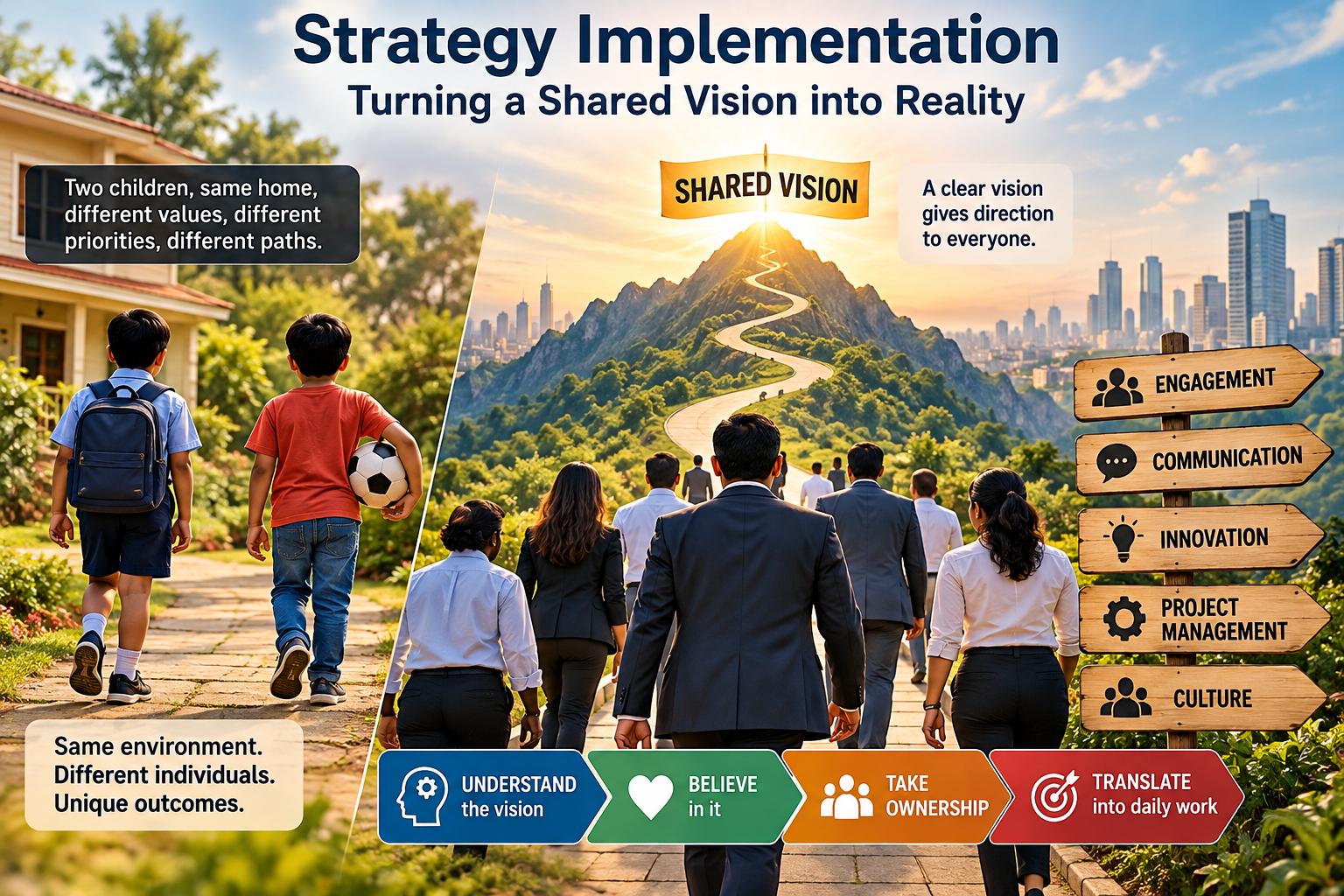
Strategy implementation is the process of turning an organisation’s shared vision into practical action. Just as children raised in the same home can develop different values and priorities, employees may respond differently to the same organisational direction. Success depends on helping people understand the vision, believe in it, and translate it into their daily work.
From Strategy to Action
Two children born to the same parents and brought up in the same home can grow up to be very different in their behaviour, obedience, values, and attitudes towards family principles. Although they share the same environment, each develops a unique personality, perspective, and set of priorities. Understanding these differences is essential for parents to guide each child effectively and help them achieve their goals in life.
The same principle applies to organisations. One of the biggest challenges in achieving organisational strategy and long-term goals is aligning employees’ individual visions, ambitions, and priorities with those of the organisation. An organisation cannot truly realise its vision unless employees at every level understand it, believe in it, embrace it, and translate it into their daily actions.
As Alexander has argued, a key reason strategy implementation fails is that executives, managers, and supervisors often lack practical models and clear guidance to turn strategy into action.
Most managers are more familiar with developing a strategy than executing it. While formulating a strategy is challenging, making it work across the entire organisation is even more difficult. A strategy has no real value unless it is effectively implemented. Even the most brilliant strategy can fail when people do not understand it, take ownership of it, or act upon it.
The Kodak Story: A Lesson in Strategy Execution
The name Kodak was once almost synonymous with photography. Until the late 1990s, it was one of the world’s most recognised brands, closely associated with cameras, film, and capturing memories.
Despite its strong brand, technological expertise, and established market position, Eastman Kodak struggled to adapt to the digital photography revolution. Its eventual bankruptcy filing in 2012 became a powerful business lesson in the dangers of failing to respond effectively to change.
Kodak’s story reminds us that past success does not guarantee future survival. Having a strategy is not enough; organisations must recognise change, make difficult decisions, align their people, and execute their plans effectively. A strategy that is not translated into timely action can become a missed opportunity.
Five Critical Elements of Successful Strategy Implementation
1. Engagement
Strategy implementation begins when people are involved in shaping the future of the organisation. When strategic decisions are made by only a small group of senior leaders, employees may feel disconnected from the direction of the business. Meaningful engagement encourages ownership, accountability, and commitment. Employees should understand not only what the organisation wants to achieve, but also why it matters and how their individual contributions support the bigger picture.
2. Communication
A strategy that is not clearly communicated cannot be effectively implemented. Every department and team must understand the organisation’s vision, priorities, and expected outcomes. Communication should not be limited to presentations, emails, or annual meetings. It must be continuous, practical, and consistent across all levels. Departmental plans and individual targets must be aligned with the overall organisational strategy. People cannot execute what they do not understand.
3. Innovation
Successful organisations need the courage to explore new ideas, challenge established practices, and take calculated risks. Innovation rarely happens when employees are afraid of making mistakes or when management expects familiar solutions to solve every new problem. As Michael Stanleigh emphasises in his work on innovation, organisations must be willing to experiment beyond what is already known to achieve meaningful breakthroughs. The objective is not to take risks blindly, but to create an environment where people can test ideas, learn from failures, and develop better solutions.
4. Project Management
A strategy becomes meaningful only when it is converted into specific actions, responsibilities, timelines, and measurable results. Every strategic objective should be supported by clear implementation plans. Employees must know what needs to be done, who is responsible, what resources are available, and how progress will be measured. Regular reviews are essential to identify delays, remove obstacles, and correct deviations before they become major problems. Without disciplined project management, even well-designed strategies can remain on paper.
5. Culture
Organisational culture determines how people behave when they are not being supervised. A strategy may promote innovation, collaboration, customer focus, or accountability, but if the existing culture discourages these behaviours, implementation will struggle. The organisation’s values, leadership behaviour, reward systems, and everyday working practices must reinforce the direction it wants to take. Culture must support the strategy, not work against it.
Conclusion: Making the Vision a Reality
Successful strategy implementation requires more than a well-written plan. It depends on engaging people, communicating priorities clearly, encouraging innovation, managing delivery with discipline, and building a culture that supports the organisation’s goals. Leaders must connect the organisation’s vision with the work people do every day, making responsibilities clear and progress visible. When people understand the purpose, accept ownership, and act together, strategy moves from a statement of intent to measurable results.
Tags: strategy-implementation, shared-vision, organisational-alignment, leadership, employee-engagement, communication, innovation, project-management, organisational-culture