KMSC Blog
Introduction
Where Strategy Becomes System, and Leaders Become Legacies.
By Dr. Sundar Subramani ·
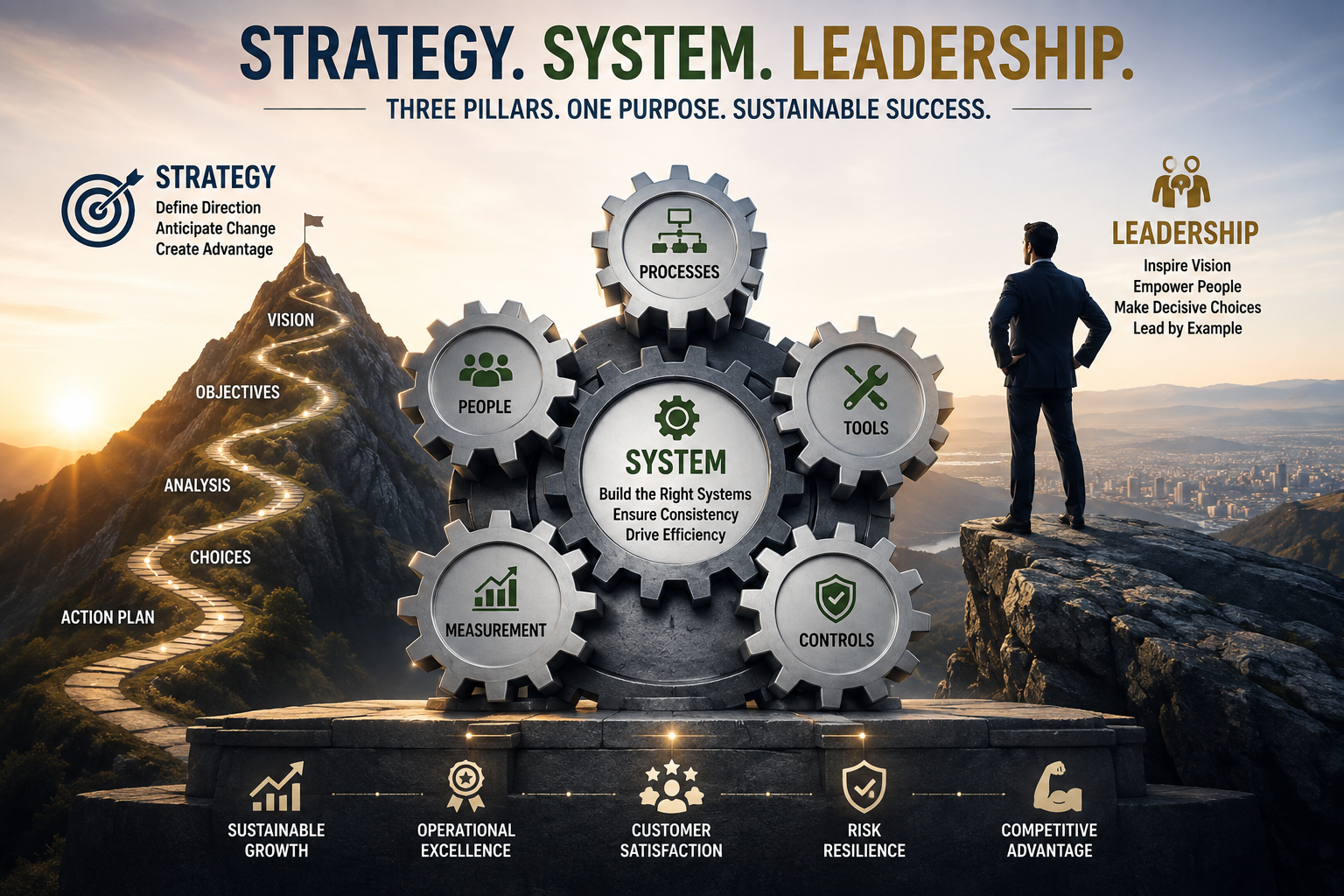
Think Strategically. Think Systematically. Lead Decisively.
In business, success rarely comes from one brilliant decision. It comes from the ability to think ahead, build the right systems, develop competent people, and make decisive choices when circumstances demand them.
This principle is deeply aligned with the management philosophy associated with Chanakya, who understood that sustainable success depends on strategy, discipline, knowledge, people and the ability to anticipate change.
For today’s business leaders, the challenge is not simply to manage the business. It is to build an organisation that can perform consistently without depending entirely on the individual at the top.
That is where a strong management system, supported by competent people and decisive leadership, becomes critical.
Think Strategically
A leader must look beyond today’s operational problems.
Where is the business going? What could threaten its sustainability? Do we have the right people and competencies to achieve our objectives? Are our decisions based on facts, or are they driven by assumptions and past experience?
Strategic thinking means understanding the connection between business objectives, opportunities, risks, people, processes, competence and organisational behaviour.
A good strategy is not simply a document prepared for management meetings. It should influence how people make decisions every day.
The real question for a business owner is:
“If I step away from the business tomorrow, will the organisation still have the capability to make the right decisions and deliver the expected results?”
If the answer is uncertain, the organisation may have a leadership dependency rather than a management system.
Think Systematically
Many organisations have policies, procedures, KPIs and processes. Yet having a system does not necessarily mean having an effective management system.
A management system becomes valuable when it connects:
Strategy → Processes → Competence → people and theirBehaviour including Performance → Continuous Improvement
When these elements operate independently, organisations often experience recurring problems.
The same mistakes happen again. Training is conducted without addressing competence gaps. Procedures exist but are not followed. Performance problems are treated as individual failures when the real issue may be the system itself.
A systematic approach looks beyond the immediate problem.
Instead of asking:
“Who made the mistake?”
we should also ask:
“Why did the system allow the mistake to happen?”
This shift in thinking can fundamentally change organisational performance.
Lead Decisively
Strategic thinking without action has little value.
Leadership requires the courage to make decisions, communicate expectations clearly and take responsibility for outcomes.
Decisive leadership does not mean making decisions quickly without sufficient information. It means having the ability to analyse, assess risk, consider alternatives and then act with clarity and accountability.
Strong leaders also understand that people do not always resist change because they are unwilling.
Sometimes they resist because they do not understand the purpose.
Sometimes they lack competence.
Sometimes the organisation’s systems make the desired behaviour difficult.
And sometimes leadership itself has failed to communicate the direction clearly.
This is why leadership development cannot be separated from human behaviour and organisational systems.
Competence Is More Than Training
One of the most common misconceptions in organisations is that training automatically creates competence.
It does not.
Training can provide knowledge and skills. Competence is demonstrated when a person can consistently apply that knowledge and skill correctly, safely and effectively in the real working environment.
A robust competence management system therefore needs to consider:
- What does the role actually require?
- What knowledge and skills are necessary?
- Can the individual demonstrate the required competence?
- How is competence evaluated?
- What behavioural factors influence performance?
- How do we identify and close competence gaps?
- How do we ensure competence is maintained over time?
This is particularly important in industries where poor decisions can have significant operational, financial, safety or reputational consequences.
Leadership Begins With Understanding People
Organisations are built around processes, but they are operated by people.
Two companies can have almost identical procedures, technology and resources, yet achieve very different results.
Why?
Because people behave differently.
Their decisions are influenced by leadership, organisational culture, competence, communication, motivation, experience, pressure and the environment in which they work.
Therefore, effective leadership coaching should not focus only on leadership techniques.
It should help leaders understand their own behaviour, the behaviour of others and the organisational environment that shapes decision-making.
Here in kautilya management system we work with you to make a robust system, that can grow n create a good leaders.
A leader who understands human behaviour can often identify the real cause of a performance problem long before it becomes a major business issue.
From Compliance to Capability
Many organisations build systems because they need to satisfy regulatory, customer or certification requirements.
That is necessary, but it should not be the final objective.
The real value of a management system is not the certificate on the wall.
It is the organisation’s capability to consistently achieve its objectives, manage risk, develop people and improve performance.
The difference is significant.
Compliance asks:
“Are we doing what the requirement says?”
Capability asks:
“Are we genuinely capable of achieving the intended outcome?”
That is the level at which management systems begin to create real business value.
Our Approach
With more than four decades of experience across maritime, production and service industries, my approach to management and leadership is built around the integration of management systems, competence, human behaviour, risk, leadership and organisational performance.
I do not believe in applying the same management solution to every organisation.
Every business has its own strategy, culture, people, risks and operational realities.
My role is therefore not simply to tell management what to do.
It is to challenge assumptions, identify systemic weaknesses, understand the human factors behind performance, develop leadership capability and help organisations create practical systems that work in the real world.
The objective is simple:
Build organisations that are less dependent on individual personalities and more capable of producing consistent, sustainable performance.
The Question Every Business Leader Should Ask
As a business owner or senior executive, you should periodically ask yourself:
If the business is growing, are our systems growing with it?
If our people are changing, are we developing the required competence?
If risks are changing, are our management decisions changing with them?
If our leaders are promoted, are we preparing them to lead people, not just manage tasks?
And perhaps most importantly:
Are we solving problems, or are we continuously treating the symptoms of deeper systemic weaknesses?
The answers to these questions can reveal more about the future of an organisation than any single KPI.
Think Strategically. Think Systematically. Lead Decisively.
This is not simply a leadership philosophy.
It is a practical approach to organisational performance.
Think strategically to understand where you want the organisation to go.
Think systematically to build the capability required to get there.
Lead decisively to turn strategy and capability into measurable results.
That is the foundation of sustainable management.
And that is where effective management systems, competence development and leadership coaching can make a meaningful difference.
The strongest organisations are not those that depend on one exceptional leader. They are those that develop exceptional capability throughout the organisation.
Tags: leadership, systems, strategy