
KMSC Blog
Training Doesn't Create Competence. Practice Does.
Want people to perform differently? Don't just train them differently. Help them practise differently. We like to imagine the brain as a hard drive: you save something once, and it's there when you need it. It doesn't work like that. Every time we recall something, the brain rebuilds it from past experience, associations, context, and how recently and how often we've used it. Think of a student preparing for an exam. They studied the subject months ago, and the knowledge is probably still in there somewhere. But on exam day, it's stubborn about showing up.
By Dr. Sundar Subramani ·
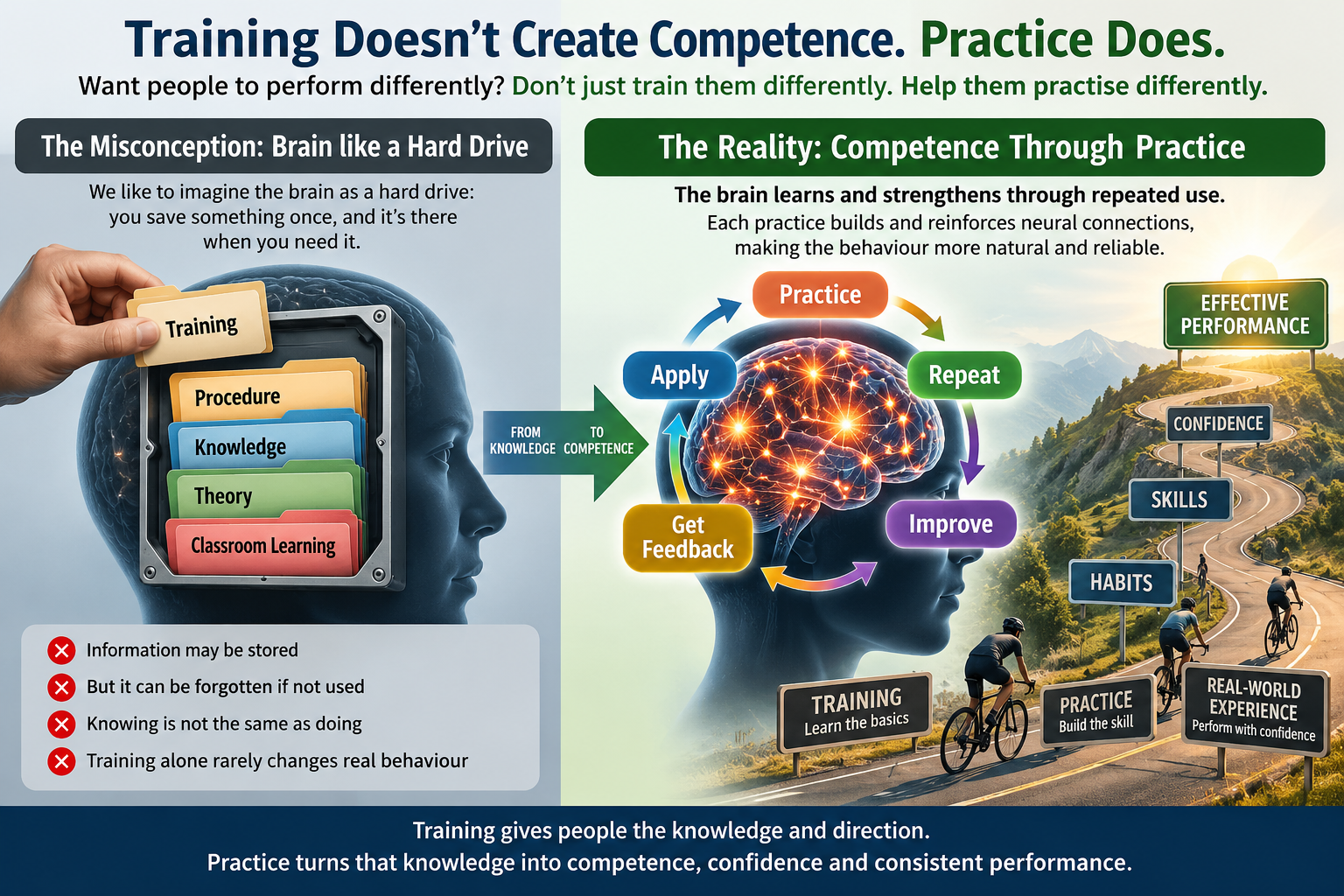
We like to imagine the brain as a hard drive: you save something once, and it's there when you need it.
It doesn't work like that. Every time we recall something, the brain rebuilds it from past experience, associations, context, and how recently and how often we've used it.
Think of a student preparing for an exam. They studied the subject months ago, and the knowledge is probably still in there somewhere. But on exam day, it's stubborn about showing up.
Then revision starts. They solve problems, recall concepts, get things wrong, and fix them. Slowly, everything becomes easier to pull out.
Why? Because the learning was brought back to life and strengthened by actually using it.
Professional competence works the same way.
A small detour into machine learning
Machine learning systems get better by seeing lots of data and picking out patterns. The more relevant and well-organised the data, the better the output.
People are obviously not machines. Still, the parallel is hard to ignore: repeated exposure, practice and feedback shape performance.
There's a catch, too. Feed a system poor data and it learns the wrong pattern. People do the same. If an employee keeps doing a task incorrectly and nobody steps in, the mistake quietly turns into a habit.
So repeating training isn't enough. We have to repeat the right behaviour.
Training is not competence
Here's where many organisations get stuck.
Someone attends a programme, passes the assessment, collects the certificate, and the training record gets closed. Done.
But has any competence actually been built? Not necessarily.
Training gives people knowledge. Competence is the ability to apply that knowledge properly and consistently in real situations.
Take leadership. Someone can sit through a two-day programme and come away understanding delegation, communication, motivation, conflict and decision-making. Then real life arrives:
That's where competence shows itself. Not in the training room, but under real conditions.
From knowledge to competence
I see this as a continuous journey:
Awareness → Knowledge → Practice → Feedback → Correction → Application → Competence
Training covers only a slice of it. The organisation has to give people chances to use what they've learned, such as:
The goal isn't to get people to remember more. It's to make the right behaviour easier to recall and show at the moment it's needed.
The trouble with training and then silence
Imagine teaching someone an emergency response procedure and then never mentioning it again until the day an emergency happens. Would you call that competence? Probably not.
Yet plenty of organisations work this way. Training at induction, a mandatory refresher once a year, attendance sheets filed, and the box is ticked.
But human performance doesn't follow the training calendar. Competence needs reinforcing all year round, especially in high-risk industries where one person's judgement can have serious consequences.
Leadership is built the same way
You can't create a leader by passing theories from a trainer to a participant. Young professionals need to practise leading.
Hand them responsibility for a project. Let them lead a small team. Ask them to sort out a conflict. Let them make decisions, and even fail safely. Give them feedback. Then give them another go.
That's how leadership competence grows. And the same goes for communication, safety behaviour, problem solving, decision-making, teamwork and technical skill.
Experience only becomes valuable when we reflect on it and turn it into learning.
So what should we measure?
Maybe it's time to stop asking only, "How many people have we trained?"
and start asking, "What changed because we trained them?"
Did behaviour change? Did performance improve? Can people actually apply what they learned? Are decisions getting better? Are mistakes being prevented? Can people respond well when circumstances shift? Are supervisors showing the behaviours we expect from leaders?
These questions move us from training management to competence management.
The leader's part in all this
A training department can offer learning opportunities. The workplace decides whether that learning turns into competence.
A supervisor who encourages the right behaviour reinforces learning. A manager who ignores poor behaviour reinforces the wrong lesson. A leader who asks questions, gives feedback and encourages reflection keeps the learning going.
So competence doesn't belong to the training department. It's a leadership responsibility.
My perspective
I've worked across maritime, production and service industries, and I've come to believe that the biggest gap in most organisations isn't a lack of knowledge. It's the gap between what people know and what people consistently do.
That's where human behaviour, competence management and leadership meet.
Organisations pour money into procedures, systems, technology and training. But in the end, systems perform through people. An organisation's real strength isn't what's written in its procedures or how many certificates are framed on the wall. It's whether its people understand, practise, apply and consistently show the behaviours that success requires.
The real question
Next time you plan a training programme, try swapping the usual question.
Not "What should we teach them?"
But "What do we want them to do differently afterwards, and how will we help them practise until it becomes competence?"
Because training creates an opportunity to learn. Practice builds capability. Feedback drives improvement. And consistent application creates competence.
That's when training stops being a cost and becomes a real business investment.
Train the mind. Practise the behaviour. Build the competence. Improve the performance.
Tags: Human Behaviour, Competence, Management, Leadership, Management Systems