KMSC Blog
WHEN CUSTOMER STANDARDSOVERTAKE REGULATIONS
A Wake-Up Call for the Maritime Industry
By Dr. Sundar Subramani ·
A Wake-Up Call for the Maritime Industry
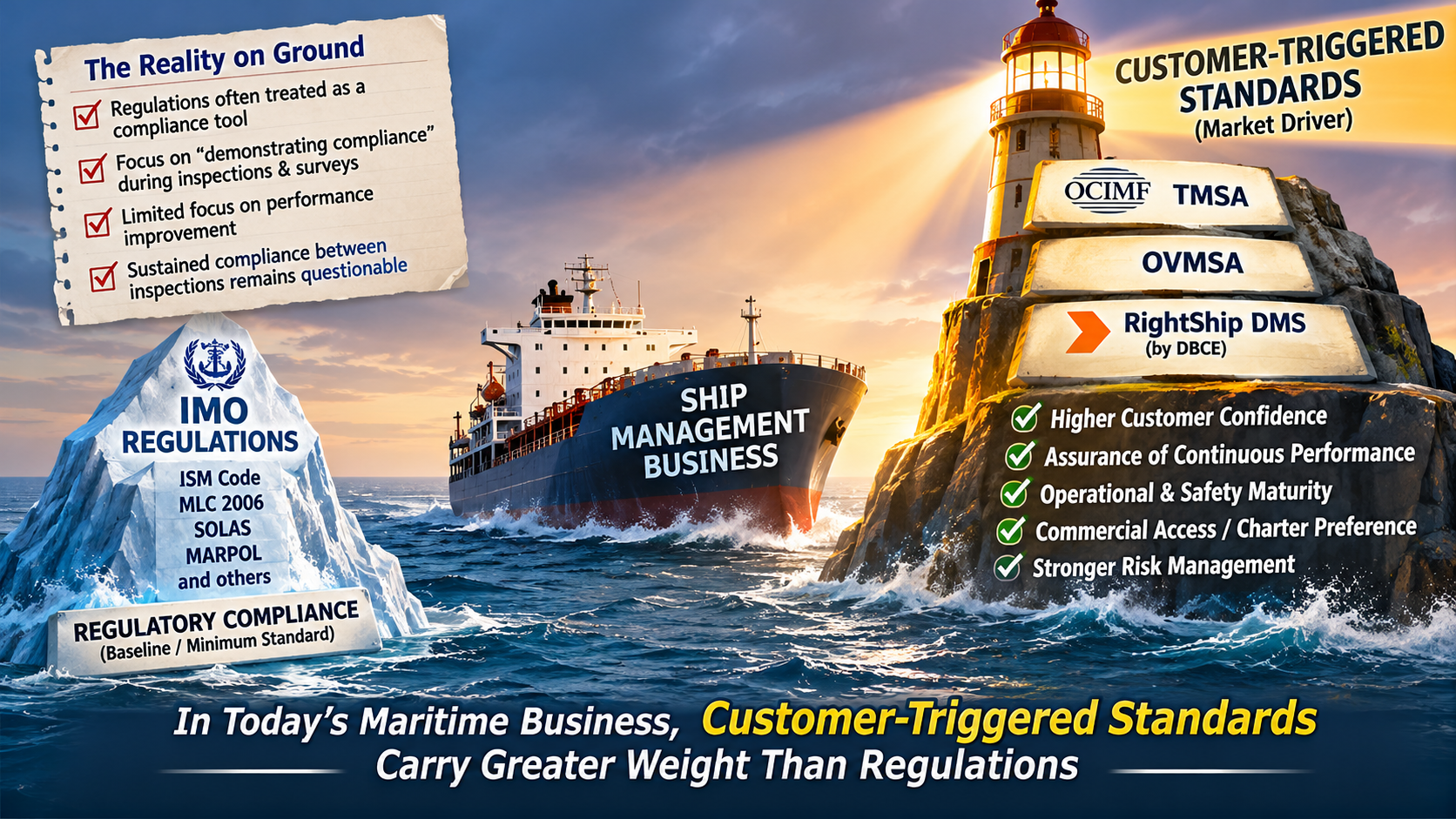
Has the maritime industry become more committed to satisfying customer expectations than to achieving the real purpose of international regulations?
The growing influence of customer-driven standards
The maritime industry is one of the most heavily regulated industries in the world. International conventions, codes and regulations establish requirements for safety, environmental protection, seafarer welfare and the effective management of ships. Instruments such as SOLAS, MARPOL, the ISM Code and the Maritime Labour Convention (MLC) provide a comprehensive framework for responsible ship operations.
Yet, despite this extensive regulatory framework, an interesting shift has taken place in the ship management business. Customer-initiated assessment and performance standards, such as OCIMF's Tanker Management and Self Assessment (TMSA), Offshore Vessel Management and Self Assessment (OVMSA), and RightShip's Dry Bulk Management Standard (DryBMS), have increasingly become powerful influences on how shipowners and ship managers conduct their businesses.
There is no doubt that customer-driven standards have contributed positively to raising management expectations in the maritime industry. They provide a structured way to assess organisational capabilities, identify gaps and encourage companies to move beyond minimum regulatory requirements.
OCIMF's TMSA provides a framework for tanker operators to assess their safety management systems against key performance indicators and progressively improve their management practices. Similarly, OVMSA encourages offshore vessel operators to evaluate their management systems against industry practices. In the dry bulk sector, DryBMS, developed by INTERCARGO and RightShip and administered through the Dry Bulk Centre of Excellence (DBCE), provides a framework covering 30 areas of management practice.
These frameworks have become important considerations in commercial relationships. Charterers and other customers use management assessments, inspection results and performance records to evaluate shipowners and operators before making commercial decisions. Consequently, achieving and maintaining acceptable performance against these standards can directly influence a company's ability to secure and retain business.
In many commercial relationships, these standards appear to receive greater management attention and priority than the regulations themselves. A shipowner may consider statutory compliance essential to maintaining certificates and operational eligibility. However, the company's ability to satisfy customer-specific expectations may determine whether the vessel is commercially attractive and whether the operator continues to receive business.
This raises an important question: why do standards introduced by customers and industry organisations sometimes have a stronger influence on ship management practices than the international regulations designed to govern the industry?
Are regulations being treated merely as a compliance exercise?
This observation comes from my professional interactions with shipowners and ship managers, as well as my experience conducting external management system audits both on board vessels and at shore-based management offices.
One recurring concern has been the way some organisations approach regulatory requirements. Regulations are often treated as obligations that need to be fulfilled to obtain certificates, pass statutory inspections, complete surveys and demonstrate compliance to external authorities. Considerable attention is given to preparing records, closing deficiencies and ensuring that the organisation is ready for the next inspection or audit.
However, the more important question is whether the requirements are being translated into consistent operational practices and measurable improvements throughout the period between two inspections or surveys.
Does a completed risk assessment genuinely influence how an operation is planned and executed?
Does an incident investigation lead to meaningful changes in behaviour and working practices?
Does an internal audit identify weaknesses before they develop into accidents or operational failures?
Does management review lead to better decisions, improved resource allocation and stronger operational controls?
Are lessons from incidents and near misses translated into improvements across the fleet?
These are the questions that determine whether a management system is actually working. The existence of documented procedures, completed checklists and closed audit findings does not necessarily demonstrate that the intended management objectives are being achieved.
The concern is not that regulations lack the necessary provisions. Rather, it is that some organisations appear to have adopted a compliance-oriented mindset instead of a performance-oriented approach.
The irony: The ISM Code already expects continuous improvement
Perhaps the most interesting aspect of this situation is that the ISM Code itself was never intended to be merely a certification or inspection requirement.
The objectives of the ISM Code include providing safe practices in ship operations and a safe working environment; assessing identified risks to ships, personnel and the environment and establishing appropriate safeguards; and continuously improving the safety management skills of personnel ashore and on board.
Section 1.2.3 requires the Safety Management System to ensure compliance with mandatory regulations and take applicable industry codes, guidelines and standards into account. In other words, the philosophy behind the ISM Code already encompasses risk management, organisational learning, industry best practices and continuous improvement.
Similarly, the MLC 2006 is not simply a document to be maintained for inspection purposes. It establishes important rights and protections relating to seafarers' employment, working and living conditions, medical care, welfare and occupational safety.
Therefore, it would be unfair to suggest that international regulations are inherently limited to minimum compliance. The regulatory framework provides the foundation for effective management. The real issue is how organisations interpret, implement and sustain those requirements.
Customer-driven standards have not necessarily introduced a completely different philosophy. In many respects, they have made expectations for management maturity, performance measurement and continuous improvement more explicit, structured and commercially visible.
Why do customer standards receive greater management attention?
There are several possible reasons.
Commercial consequences are more immediate. A poor customer assessment, an unsatisfactory inspection result or an inadequate management evaluation can affect chartering decisions and future business opportunities. The commercial consequences are often immediately visible to senior management.
Performance expectations are more measurable. Standards such as TMSA and DryBMS provide structured assessment criteria and different levels of attainment. This makes it easier for customers to compare management capabilities and for shipowners to identify areas requiring improvement.
Customer requirements are closely connected to business continuity. For a ship management company, retaining customers and securing new business are fundamental commercial objectives. Consequently, customer-driven standards often receive direct attention from business development, fleet management and senior leadership.
Regulatory compliance can become routine. When statutory compliance is approached primarily as a certification requirement, organisations may become accustomed to preparing for inspections rather than continuously evaluating the effectiveness of their management systems.
This creates an unintended situation in which organisations become highly responsive to customer assessments while the broader purpose of regulatory requirements receives less consistent attention.
The danger of managing for the next inspection
One of the greatest risks of this approach is the possibility of developing two different management behaviours.
The first is the behaviour demonstrated during customer inspections, external audits and statutory surveys, when the organisation is prepared to demonstrate that its systems are functioning effectively. The second is the behaviour that exists during normal operations, when the immediate pressure of an upcoming inspection or assessment is absent.
If the two are significantly different, the organisation may have a management system that performs well during assessments but does not consistently deliver the intended results in everyday operations.
Are we managing ships to achieve safe and efficient operations, or are we managing them to demonstrate that we are capable of doing so when someone comes to inspect us?
The distinction is important. A well-maintained audit record does not necessarily mean that risks are effectively controlled. A high assessment score does not automatically establish that people consistently follow safe practices. Similarly, a satisfactory inspection report does not guarantee that the management system is delivering sustainable operational performance.
The real test of a management system is not how well it performs during an inspection, but how effectively it protects people, assets and the environment when nobody is watching.
Customer-driven standards should complement, not overshadow, regulations
I believe the maritime industry should recognise customer-driven standards as valuable instruments for improving management performance. Their contribution to raising expectations and encouraging organisations to adopt better practices should not be underestimated. However, they should not become substitutes for the philosophy and objectives of international regulations.
There is a need to bring these two approaches together. Rather than maintaining separate priorities for statutory compliance and customer assessments, shipowners and managers should develop an integrated management approach in which customer standards strengthen the implementation of regulatory requirements.
Risk management should be driven by actual operational risks, not by the need to satisfy an assessment question.
Incident investigation should focus on understanding underlying causes and preventing recurrence, not merely closing findings.
Competence management should establish the ability of people to perform their responsibilities effectively, rather than simply demonstrate training attendance.
Maintenance management should ensure equipment reliability and operational readiness, rather than just satisfy inspection requirements.
Leadership and safety culture should influence everyday decisions and behaviour, rather than exist only as documented commitments.
Management reviews should evaluate actual performance and identify improvement opportunities, rather than simply confirm that scheduled reviews have taken place.
These practices should be embedded in the company's management system and evaluated continuously. The objective should be to achieve regulatory compliance, customer satisfaction and operational excellence through one effective management system.
A change in management mindset is necessary
Ultimately, the issue is not about choosing between regulations and customer standards. Both have an important role in improving the maritime industry. The issue is about the mindset with which shipowners and ship managers approach them.
Regulations establish the obligations and fundamental principles. Industry standards provide additional guidance and performance expectations. Customers create commercial incentives for achieving higher standards. But it is the responsibility of organisational leadership to convert all these expectations into consistent management practices and operational performance.
Shipowners and managers should stop viewing regulations as something to comply with before the next inspection and customer standards as something to satisfy before the next commercial assessment. Instead, they should ask themselves a more fundamental question:
Are our management systems genuinely improving the way we operate ships, manage risks, develop people, maintain assets and protect the environment?
If the answer is yes, statutory inspections, customer assessments and external audits should become opportunities to verify the effectiveness of the management system rather than occasions to prepare a demonstration of compliance.
My concluding thought
The maritime industry does not necessarily need more standards, more checklists or more frequent assessments. It needs organisations that understand the purpose behind the standards they already have.
COMPLIANCE SHOULD BE THE STARTING POINT, NOT THE DESTINATION.
A robust system should be developed and implement for a consistent operation between two external inpections or verification
A regulation should not be treated as an obligation to demonstrate compliance during an inspection. It should be treated as a management commitment that influences decisions and behaviour every day.
Likewise, a customer-driven standard should not become another certificate or assessment score to pursue simply to remain in business. It should be an instrument for improving the organisation's ability to manage risks, develop competence and deliver sustainable operational performance.
The true measure of a ship management company's effectiveness is not how many inspections it passes or how high it scores in customer assessments. It is how consistently it achieves safe, reliable and responsible operations between those assessments.
Ultimately, the objective should not be to build a management system that is ready for an audit. It should be to build an organisation that is ready for the challenges of everyday operations.
References and further reading
IMO: International Safety Management (ISM) Code https://www.imo.org/en/OurWork/HumanElement/Pages/ISMCode.aspx
IMO Resolution A.1188(33): Guidelines on Implementation of the ISM Code https://www.imo.org/
ILO: Maritime Labour Convention, 2006 https://www.ilo.org/global/standards/maritime-labour-convention/lang--en/index.htm
OCIMF: Management Self-Assessment, TMSA and OVMSA https://www.ocimf.org/
DBCE: DryBMS https://www.dbce.org/
INTERCARGO https://www.intercargo.org/